
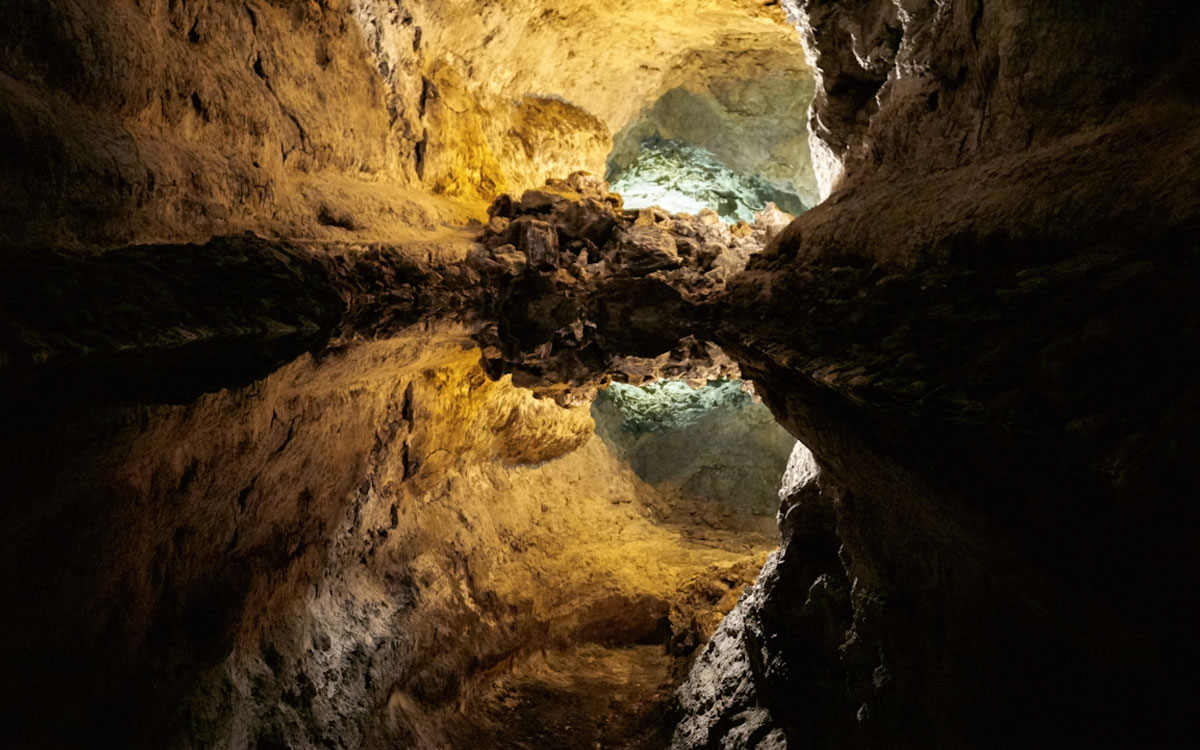
Lanzarote, the “Island of Volcanoes,” hides a network of underground passages that are a fascinating testament to its geological history. Formed by ancient eruptions, the lava tunnels in Lanzarote are a natural phenomenon that has created some of the most astonishing landscapes in the Canary Islands.
Today, on the First Minute Excursions and Last Minute Transfer blog, we invite you to venture inside—it’s a journey to the heart of the Earth, an experience that blends geology, adventure, and art.
Exploring the lava tunnels in Lanzarote
The lava tunnels in Lanzarote were formed during the eruption of the La Corona volcano around 20,000 years ago.
As molten lava flowed from the volcano toward the sea, the outer layer cooled and solidified, creating a crust. Inside, however, the lava kept moving, leaving behind a hollow conduit once the eruption ended. This process gave rise to a system of galleries and caves over six kilometres long.
These tunnels aren’t mere caves; they’re true natural works of art. Their walls and ceilings are adorned with lava stalactites and stalagmites—formations that look like abstract sculptures carved by the force of nature.
The most famous tunnels and their secrets
The best-known part of this tunnel system is the section adapted for visitors, now a must-see on the island.
Jameos del Agua
Created by the genius of César Manrique, Jameos del Agua is a perfect fusion of art and nature. Manrique transformed a collapsed section of the tunnel into an auditorium, a turquoise pool, and a cactus garden. The jameo (an opening in the tunnel’s roof) is home to a unique endemic species: the tiny blind albino crabs (Munidopsis polymorpha).
Cueva de los Verdes
This stretch of the tunnels offers a more purely geological experience. It’s a walking route that takes you through dark galleries and narrow passages. It’s one of Lanzarote’s most impressive caves, and its history is as fascinating as its geology. In the past, locals used it to hide from pirates and invaders.
Túnel de la Atlántida: the underwater section (science only)
The tube continues beneath the sea in the Túnel de la Atlántida, with about 1.6 km flooded and ~64 m maximum depth according to recent studies. It is also the longest known submarine volcanic tunnel in the world. Access is restricted and reserved for research and authorised technical cave diving.
Why is Lanzarote perfect for learning geology?
Because the entire system lies within the UNESCO Global Geopark Lanzarote and Chinijo Archipelago, which protects and promotes this volcanic heritage. Active research here focuses on the tube’s morphology, speleothems, and biodiversity (yes—projects with links to planetary exploration, too).

Leave A Comment