
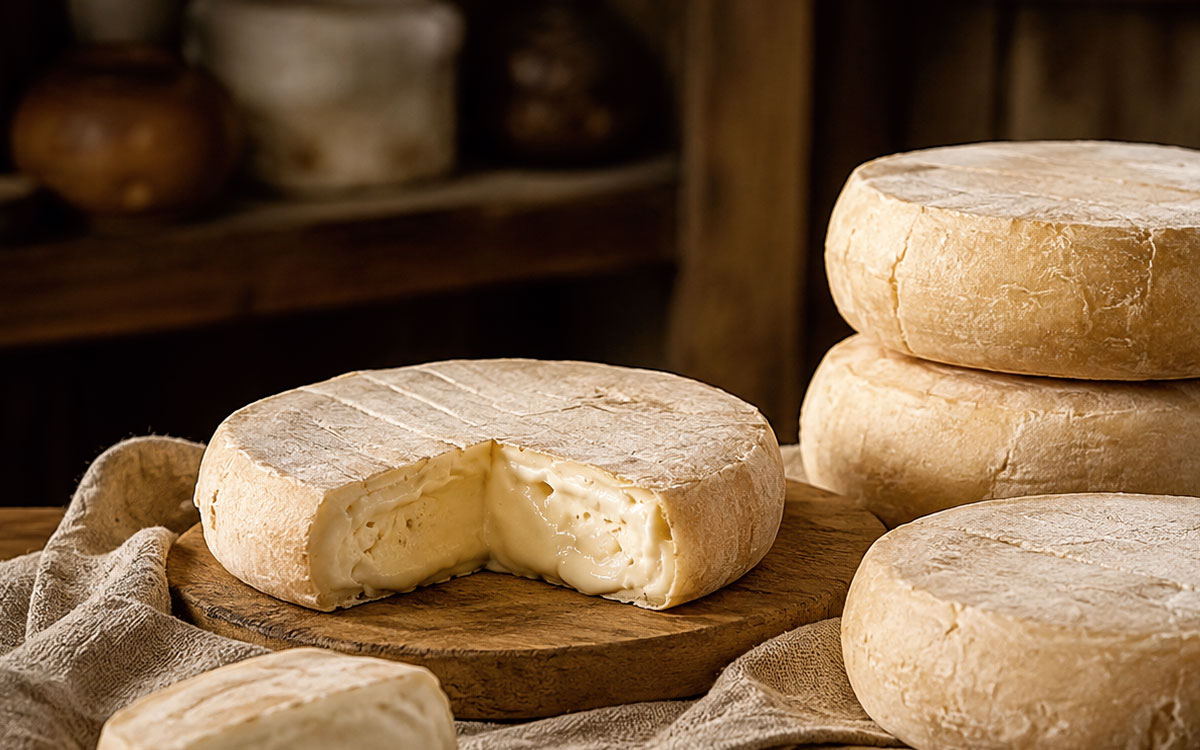
Among the flavours that best explain northern Gran Canaria, Queso Flor de Guía has an identity that is difficult to confuse with any other cheese. Its use of plant-based rennet from cardoon flowers, the predominance of Canary Island sheep’s milk and its close relationship with Santa María de Guía, Gáldar and Moya make it a genuine expression of the territory.
At First Minute Excursions and Last Minute Transfer, we also like to explore Gran Canaria through its gastronomy, because some local foods can explain the landscape, livestock traditions and history of the island particularly well.
What makes Queso Flor de Guía different?
Its most distinctive characteristic is the way the milk is coagulated. Queso de Flor uses exclusively plant-based rennet obtained from dried cardoon flower heads, from specific Cynara varieties recognised by the Protected Designation of Origin.
This is not simply an additional flavouring. The vegetable coagulant directly influences the cheesemaking process and contributes to the characteristic texture, aroma and flavour.
The composition of the milk is also regulated. Canary Island sheep’s milk must represent at least 60% of the total, while Canary Island cow’s milk and its crosses may account for up to 40% and milk from Canary Island goat breeds for a maximum of 10%.
The name therefore refers to a clearly defined product rather than any cheese produced in northern Gran Canaria.
Flor, Media Flor and Queso de Guía are not the same
The Protected Designation of Origin includes three related but distinct cheeses: Queso de Flor de Guía, Queso de Media Flor de Guía and Queso de Guía.
For Queso de Flor, coagulation is carried out exclusively with vegetable rennet from cardoon flowers.
Queso de Media Flor de Guía uses cardoon-based vegetable rennet for more than 50% of the coagulation process, combined with other authorised options.
Queso de Guía can use animal or vegetable rennet, as well as other authorised coagulants.
These differences help explain why texture and flavour can vary considerably even though all three cheeses share the same protected geographical area and much of the same raw material.
How is it made?
Production begins by filtering the milk before coagulation takes place.
For the Flor variety, this step uses only an aqueous extract made from dried cardoon flowers. Once the curd has formed, it is worked to separate the whey before moulding and pressing.
The cardoon flower actively participates in transforming the milk, which is why it is such an important part of the cheese’s identity.
Maturation follows. Under the Protected Designation of Origin, semi-cured cheeses are matured for between 15 and 60 days, while cured cheeses mature for more than 60 days.
As time passes, texture, colour, aroma and intensity change. Younger cheeses are noticeably softer and creamier, while longer maturation creates a firmer cheese with stronger flavours.
A cheese connected to Santa María de Guía, Gáldar and Moya
The protected production, cheesemaking and maturation area is restricted to Santa María de Guía, Gáldar and Moya, in north-western Gran Canaria.
This geographical relationship is more than an administrative boundary. Differences in altitude, microclimates, natural pastures and a long livestock tradition have all shaped cheesemaking in this part of the island.
Protected production is also strongly seasonal. Cheeses covered by the designation must be produced between January and July.
This helps explain how closely gastronomy and landscape are connected here. Moya, for example, also forms part of the green landscapes explored in our article about Parque Rural de Doramas and Finca de Osorio.
How to identify a protected cheese
The full designation covers Queso de Flor de Guía, Queso de Media Flor de Guía and Queso de Guía.
Products sold under the Protected Designation of Origin must comply with requirements governing milk origin, cheesemaking and maturation and form part of the corresponding control system.
Identification and numbered labelling help distinguish protected cheeses from other products made with different methods or outside the designated area.
This is an important distinction. A cheese being made in Gran Canaria, or even using similar ingredients, does not automatically mean that it belongs to this Protected Designation of Origin.
Flavour, texture and maturation
The character of Queso Flor de Guía changes significantly as it matures.
Semi-cured examples have a cream-coloured paste and a very soft, creamy consistency. Their aroma profile includes dairy and vegetal notes linked to cardoon flowers, as well as hints of nuts.
On the palate, acidity and characteristic bitter notes form part of its identity, something that can surprise people expecting an entirely mild cheese.
Cured cheeses become firmer and develop greater intensity, with slightly spicy sensations possible as maturation advances.
There is therefore no single tasting profile. The amount of time the cheese spends maturing has a considerable influence on the final experience.
Understanding the cheese through northern Gran Canaria
To understand this product properly, it helps to look beyond the finished cheese.
Queso Flor de Guía brings together local livestock, cheesemaking knowledge, seasonality, vegetation and a clearly defined territory. Its gastronomic value comes precisely from this connection.
A route through northern Gran Canaria can pass through places as different as Arucas, Moya, Gáldar and Santa María de Guía, revealing a very different island from the better-known southern resorts.
Local food becomes much more meaningful when we understand why it developed in that particular place.
In this case, every cheese reflects a distinctive coagulation technique, Canary Island livestock breeds, seasonal production and a cheesemaking tradition rooted in the north-west of Gran Canaria.
That combination, rather than exaggerated descriptions or tourist clichés, is what makes this one of the island’s most distinctive gastronomic products.

Leave A Comment